

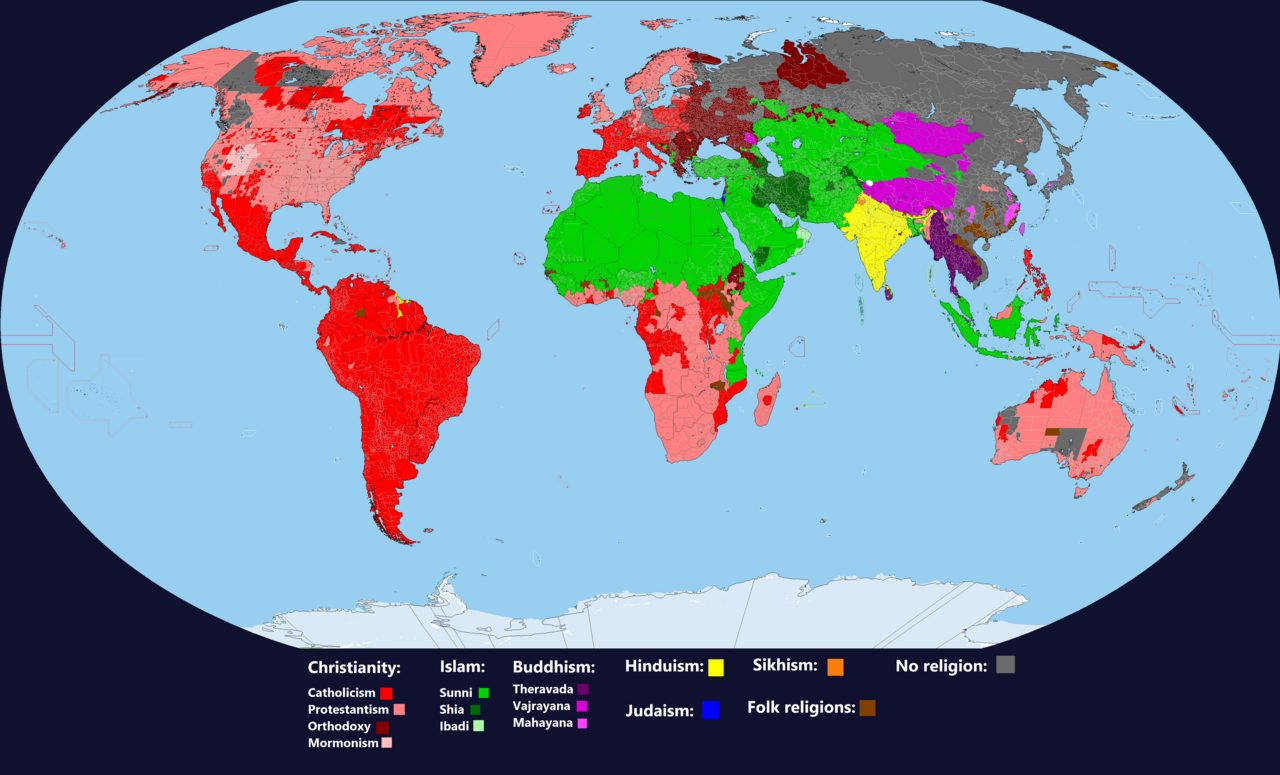
The sheer scale of unbelief in the world is said to fit naturalism better than theism.
Tagged: Arguments against God
Millions of people do not believe in God, and many have never encountered theistic belief in a form they found persuasive. On theism, one might expect a God who desires relationship with human beings to make belief widely available and compelling. On naturalism, by contrast, the spread of belief and unbelief across cultures and centuries is exactly what one would expect from human history, education, and psychology.
The argument therefore claims that the pattern of non-belief is more probable on naturalism than on theism, and that this difference in probability counts as evidence against God's existence.
The Argument in Form
- If theism is true, belief in God would be widely available and compelling to sincere seekers.
- Non-belief is widespread, including among sincere seekers.
- Widespread non-belief is more probable on naturalism than on theism.
Conclusion: Therefore, the pattern of non-belief counts as evidence against theism.
Proponents and History
Theodore Drange developed the argument from non-belief in the late twentieth century, arguing that the distribution of belief is difficult to square with a God who wants to be known. The argument overlaps with the problem of divine hiddenness, but it is broader: it appeals not only to reasonable non-belief but to the whole pattern of belief and unbelief across the world. Later writers have pressed both its evidential force and its limits.
Standard Responses
Theists reply along the lines used against divine hiddenness: human freedom and resistance can explain why belief is not universal, and a God who values free response may permit people to turn away. They also contest the evidential weight of the pattern, arguing that belief is in fact widespread across human history and that many forms of unbelief reflect culture, education, or moral resistance rather than a lack of available evidence. The pattern, they argue, is consistent with theism once those factors are weighed. The argument therefore raises a genuine question about the distribution of belief without settling it.
References
- Divine Hiddenness (Stanford Encyclopedia of Philosophy) Free / open access
- Atheism and Agnosticism (Stanford Encyclopedia of Philosophy) Free / open access
Related Across the Site
- Cosmological Disproof Argument — Modern cosmology is said to remove the need for a first cause of the universe.
- Divine Hiddenness Argument — If God were perfectly loving, reasonable people would not remain without belief; yet many do.
- Foreknowledge and Free Will Argument — If God already knows infallibly what each person will do, the future seems fixed and human freedom seems lost.
- Omnipotence Paradox / Coherence of Theism Argument — The stone paradox asks whether a God who can do anything can make a stone too heavy for God to lift.
- Omnipotence and Omniscience Incoherence Argument — The divine attributes themselves are said to conflict, so that no being could hold them all together.
- Ontological Disproof Argument — The ontological argument is said to fail because existence is not a property that can be built into a definition.
- Problem of Evil Argument — The suffering of the world is said to count against a God who is all-powerful, all-knowing, and perfectly good.
- Teleological Disproof Argument — Evolution and natural explanations of fine-tuning are said to remove the need for a designer.
Related Arguments
- Divine Hiddenness — If God were perfectly loving, reasonable people would not remain without belief; yet many do.
- Problem of Evil — The suffering of the world is said to count against a God who is all-powerful, all-knowing, and perfectly good.
- Argument from Religious Experience — Widespread and persistent religious experiences are best explained by a transcendent reality that people genuinely encounter.