

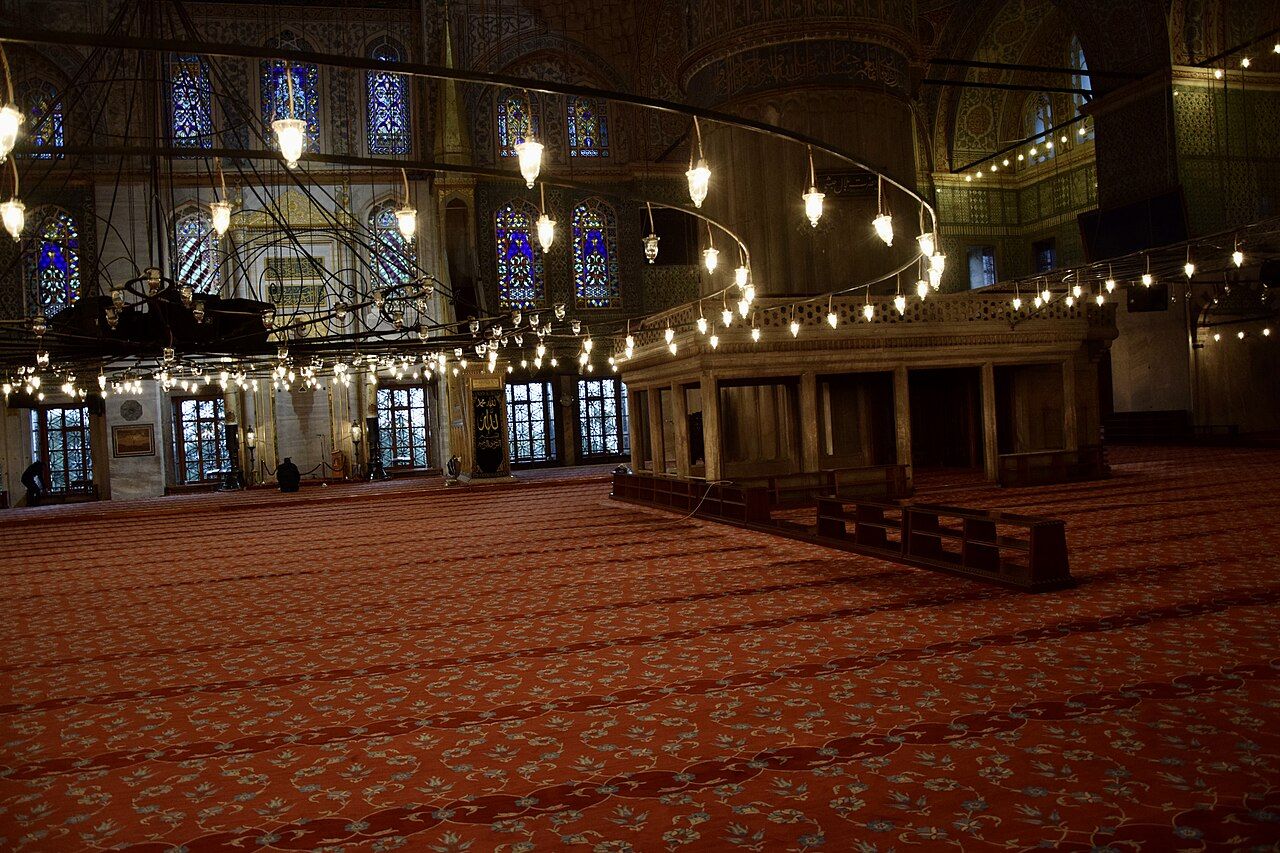
A civilization whose law needed astronomy and whose scripture points to nature’s signs; today the fiqh academies reason case by case under necessity and public benefit, while evolution remains an open argument inside the tradition.
Islam’s scientific heritage is institutional as well as intellectual: the same civilization that produced algebra, the observatory, and the hospital (bīmāristān) framed inquiry as ʿilm, a religious good, and the signs (āyāt) of God as located in nature and scripture alike. The Golden Age profile in this section’s eras records the achievement and its internal arguments, including al-Ghazālī’s reservation of metaphysics and Ibn Rushd’s harmony thesis.
Contemporary Muslim responses to new science run through the fiqh academies and national fatwa councils, which issue reasoned rulings on organ transplantation, IVF (permitted within marriage; third-party gametes divide Sunni and Shia authorities), genetic screening, and end-of-life care, usually by the principles of necessity (ḍarūra), public benefit (maṣlaḥa), and the objectives of the law (maqāṣid). On evolution, the landscape is genuinely contested: from full acceptance by many scientists of Muslim heritage to the popular creationism of Harun Yahya’s publishing empire to a middle literature seeking an Adam-exception within an evolved creation.
Recorded Stances in the Register
Contraception Regulated
Classical fiqh permitted contraception within marriage (coitus interruptus is discussed in hadith without condemnation), and modern councils permit most reversible methods subject to spousal consent, refusing permanent sterilization except under necessity; state family-planning programs in Iran and Indonesia were run with clerical endorsement.
Embryonic stem cell research Regulated
Ensoulment traditions (commonly 120 days, some say 40) place early embryos outside full personhood; the Islamic Organization for Medical Sciences permits research on surplus embryos before ensoulment under conditions, and the fiqh academies prohibit creating embryos for research while permitting the surplus case — a distinction several Western frameworks independently converge on.
Evolution by natural selection Contested within the tradition
Qur’anic creation language and the Adam narrative generate a genuine spread: scientific exegesis that reads evolution into the text, an Adam-exception model (evolved humanity, specially created Adam), widespread popular creationism (the Harun Yahya literature), and working Muslim biologists who accept the theory entire. The fiqh academies have not issued a single binding line.
Germline gene editing Regulated
Fiqh academies approach germline editing through necessity and the protection of progeny (ḥifẓ al-nasl, one of the law’s objectives): somatic therapy is widely permitted in principle; germline changes attract caution and frequent refusal because they alter what God has entrusted to descent, and because error propagates to generations who cannot consent.
Human reproductive cloning Condemned
The fiqh academies refused reproductive cloning at their 1997 Casablanca session and after, citing the confusion of lineage and the integrity of God’s creation, while permitting plant and animal cloning and cell research under conditions.
In vitro fertilization Regulated
IVF within marriage using the spouses’ own gametes is permitted by the major fatwa councils (Al-Azhar’s line since 1980); third-party gametes are refused by Sunni authorities as a confusion of lineage (nasab), while Shia jurisprudence in Iran permits donation under conditions — a clean Sunni–Shia divergence on one technology.
Organ transplantation Regulated
Fiqh academies permit transplantation under conditions — necessity, donor consent, no sale — with the Islamic Fiqh Academy’s resolutions of the 1980s as the standard texts; the body as God’s trust (amāna) generates both the permission and its limits.
Surgical and medical abortion Contested within the tradition
The classical fiqh ties protection to ensoulment (commonly 120 days): abortion after ensoulment is forbidden except to save the mother; before it, the schools divide (Hanafi latitude under excuse, Maliki strictness), and contemporary councils restate these positions with modern indications added case by case.
The printing press Regulated
Ottoman authorities licensed printing selectively: minority presses printed in their own scripts from the 1490s while Arabic religious texts remained scribal until 1727, when Müteferrika’s press was authorized for secular works. The delay is usually ascribed to the scribes’ guilds and calligraphy’s sacred status rather than to a doctrine against print as such.
The telescope Embraced
Ottoman astronomers adopted the telescope within years of its invention (Taḳī al-Dīn’s Istanbul observatory already worked with the best pre-telescopic instruments). The instrument entered Islamic astronomy as an instrument; no fatwa against it exists, and its historians record use without controversy.
Vaccination Regulated
Fatwa councils in Egypt, Saudi Arabia, and Indonesia have ruled vaccination permissible and in outbreaks obligatory, against periodic boycott campaigns; the Indonesian Ulema Council’s 2018 ruling on the measles-rubella vaccine (declared religiously impermissible in content but permitted under emergency until a halal alternative exists) shows the tradition’s necessity doctrine doing precise work.
References
- George Saliba, Islamic Science and the Making of the European Renaissance (2007)
- Muzaffar Iqbal, Islam and Science (2002)