

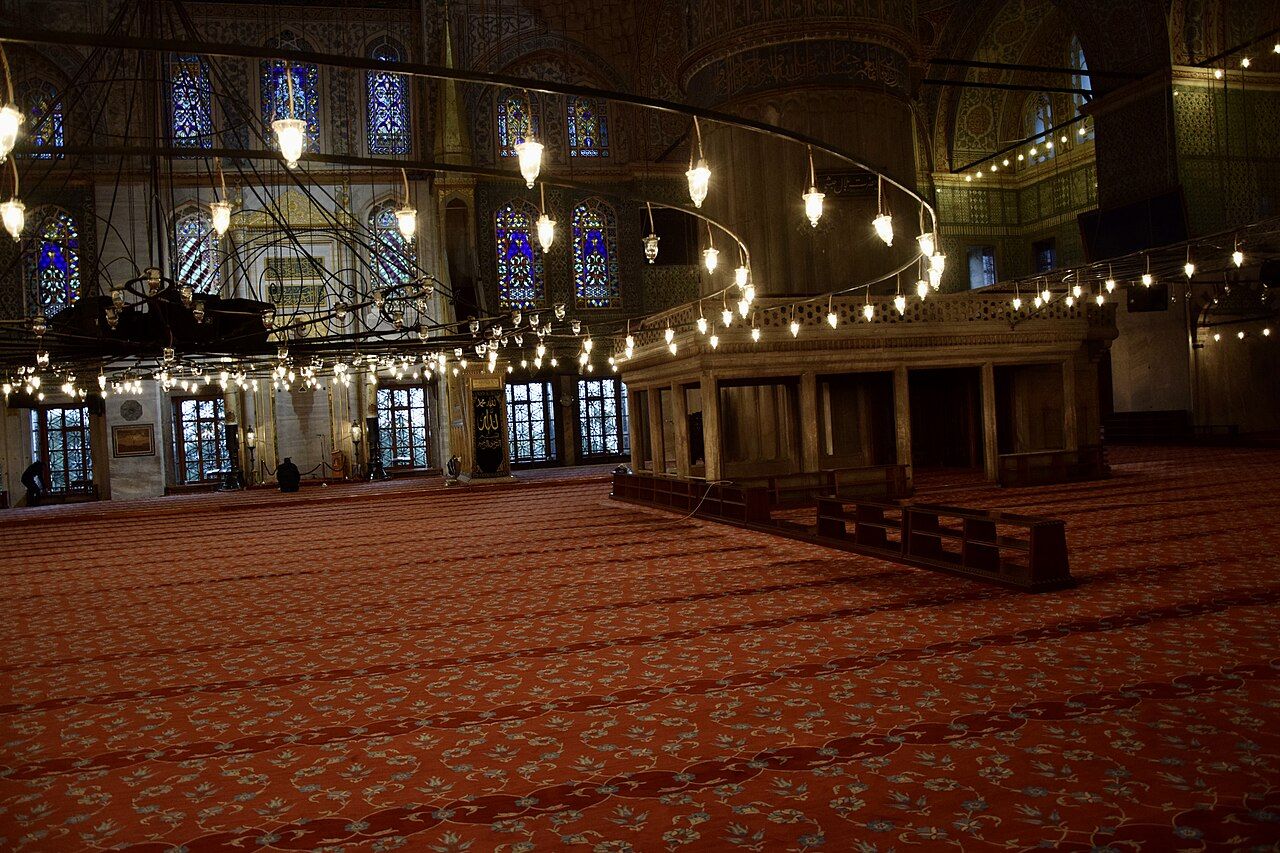
For the month of Ramadan, from dawn to sunset, the fast from food, drink, and desire — broken nightly with family and prayer, and crowned by the Night of Decree.
Tagged: Community Fasting Sacred time
How It Is Practiced
The fast begins at dawn with a pre-fast meal (suḥūr) and ends at sunset with ifṭār, traditionally dates and water, then a feast and the extra night prayers (tarāwīḥ) in which the Qur'an is recited through the whole month. Children, the ill, travelers, and nursing mothers are exempted by the law itself. In the last ten nights, worshippers seek Laylat al-Qadr, the Night of Decree, 'better than a thousand months,' when the Qur'an first descended; many spend those nights in the mosque entirely (iʿtikāf).
Purpose and Meaning
The Qur'an gives the fast its purpose in one clause: 'so that you may become God-conscious' (taqwā). Hunger is the tutor: the body learns monthly that appetite is not master, the rich learn the poor's ordinary day, and the will is trained on the smallest denials so it can be trusted with larger ones. It is the most communal of Islamic devotions — a whole civilization keeping the same hours for a month.
References
- Ramadan — Wikipedia Free / open access
- Fasting in Islam — Wikipedia Free / open access
Related Practices
- Fasting (Orthodox) — Orthodox fasting keeps set seasons and weekdays free of meat, dairy, and often oil and wine, joined to prayer and almsgiving.
- Vrata — Votive Fasts and Vows — A vrata is a vow undertaken for a set term — a fast day kept, a food renounced, a rite performed — for the good of oneself or of those one loves.
- Ṣalāh — The Five Daily Prayers — Five times a day, at hours set by the sun, Muslims stop and pray: the standing, bowing, and prostration that structure the Islamic day.
Related Across the Site
- Fasting (Orthodox) Devotion — Orthodox fasting keeps set seasons and weekdays free of meat, dairy, and often oil and wine, joined to prayer and almsgiving.
- Jumuʿah — The Friday Prayer Devotion — At noon on Friday the community gathers for a sermon and a shortened prayer: the week's public devotion, commanded in the Qur'an itself.
- Laṅgar and Sevā — The Sacred Kitchen Devotion — Devotion as service: the gurdwara's free kitchen feeds all comers, seated in one line on the floor, cooked and served by volunteers as worship.
- The Bahá'í Fast Devotion — For the nineteen days of the month of ʿAlāʾ, the last month before the spring New Year, Bahá'ís fast from sunrise to sunset.
- The Nineteen Day Feast Devotion — Every nineteen days, at the opening of each Bahá'í month, the community gathers for devotion, consultation, and fellowship — the basic unit of Bahá'í communal life.
- The Sabbath Table Devotion — Friday night's table — candles, wine, two loaves, blessings, and song — is the home liturgy at the center of Jewish devotion.
- Uposatha — The Observance Days Devotion — On the moon's quarters, lay Buddhists intensify their practice: eight precepts instead of five, white clothes, the temple for the day, and sermons until night.
- Vrata — Votive Fasts and Vows Devotion — A vrata is a vow undertaken for a set term — a fast day kept, a food renounced, a rite performed — for the good of oneself or of those one loves.