

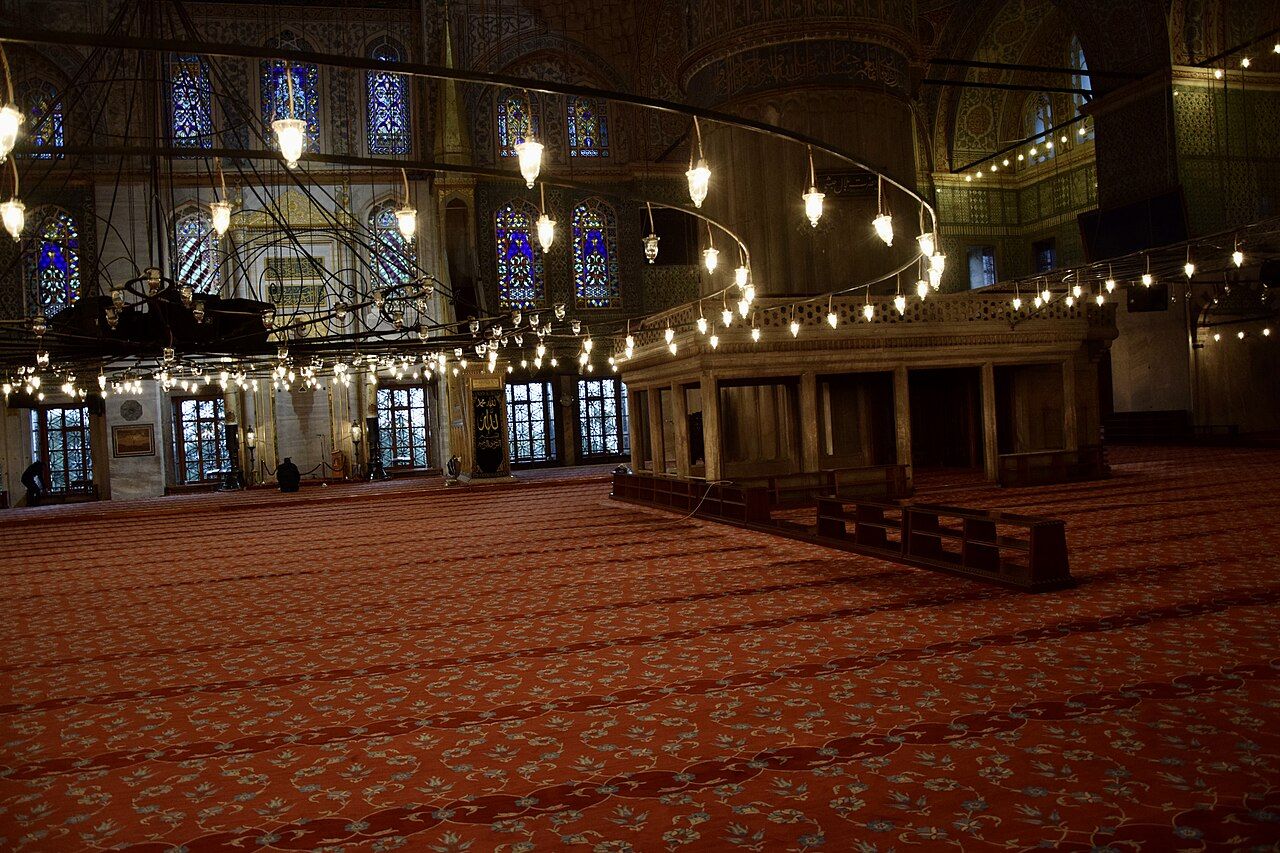
Five times a day, at hours set by the sun, Muslims stop and pray: the standing, bowing, and prostration that structure the Islamic day.
Tagged: Daily Prayer Prayer Sacred time
How It Is Practiced
The prayers — Fajr at dawn, Ẓuhr at midday, ʿAṣr in the afternoon, Maghrib at sunset, ʿIshāʾ at night — are preceded by wuḍūʾ, the ritual washing of hands, face, and feet. Each prayer is a set number of cycles (rakʿāt) of standing to recite al-Fātiḥa and further verses, bowing, and prostrating with the forehead to the ground, in Arabic, facing the qibla, the direction of the Kaaba. The prayers may be said at home, at work, or in the mosque; the call to prayer (adhān) marks them over the city.
Purpose and Meaning
Ṣalāh is named in the Qur'an as the believer's covenant kept in time: 'Indeed, prayer has been decreed upon the believers at specified times.' Its devotion is embodied and punctual — the body bows on schedule, five times interrupting commerce, sleep, and argument. The prostration, forehead in the dust, is the posture the tradition prizes most: the servant nearest to God, it says, is the one prostrating.
References
- Salah — Wikipedia Free / open access
Related Practices
- Jumuʿah — The Friday Prayer — At noon on Friday the community gathers for a sermon and a shortened prayer: the week's public devotion, commanded in the Qur'an itself.
- Dhikr — The Remembrance of God — Dhikr is the repeated invocation of God's names and phrases — Subḥān Allāh, Alḥamdu lillāh, Allāhu akbar — counted on beads until remembrance becomes a state.
- The Three Daily Prayers — Jewish devotion is structured by three daily services — morning, afternoon, and evening — built around the Shema and the Amidah.
Related Across the Site
- The Obligatory Prayers Devotion — Each day the Bahá'í chooses one of three revealed obligatory prayers — short, medium, or long — the fixed point of Bahá'í devotion.
- The Three Daily Prayers Devotion — Jewish devotion is structured by three daily services — morning, afternoon, and evening — built around the Shema and the Amidah.
- Al-Fatiha Prayer or Creed — The opening chapter of the Qur'an, recited in every unit of the ritual prayer.
- Amidah Prayer or Creed — The standing prayer at the center of every Jewish prayer service, recited silently while standing.
- Jesus Prayer Prayer or Creed — A short, repeated invocation of Jesus asking for mercy, central to the Orthodox hesychast tradition.
- Salah Prayer or Creed — The ritual prayer performed five times daily, with fixed postures, recitations, and the closing testimony (Tashahhud).
- The Angelus Prayer or Creed — A thrice-daily prayer of versicles and Hail Marys commemorating the Annunciation and the Incarnation.
- The Lord's Prayer (Our Father) Prayer or Creed — The prayer Jesus taught his disciples in Matthew 6 and Luke 11, shared by Christians of every tradition.