

Relativity, quantum theory, and a priest’s Big Bang; war made science a state enterprise and the scientist’s conscience a public problem; creation-evolution litigation defined the American quarrel while genetics under Lysenko showed the cost of policing conclusions.
Tagged: Astronomy and cosmology Biology and evolution Medicine and anatomy Physics Warfare Catholic Jewish
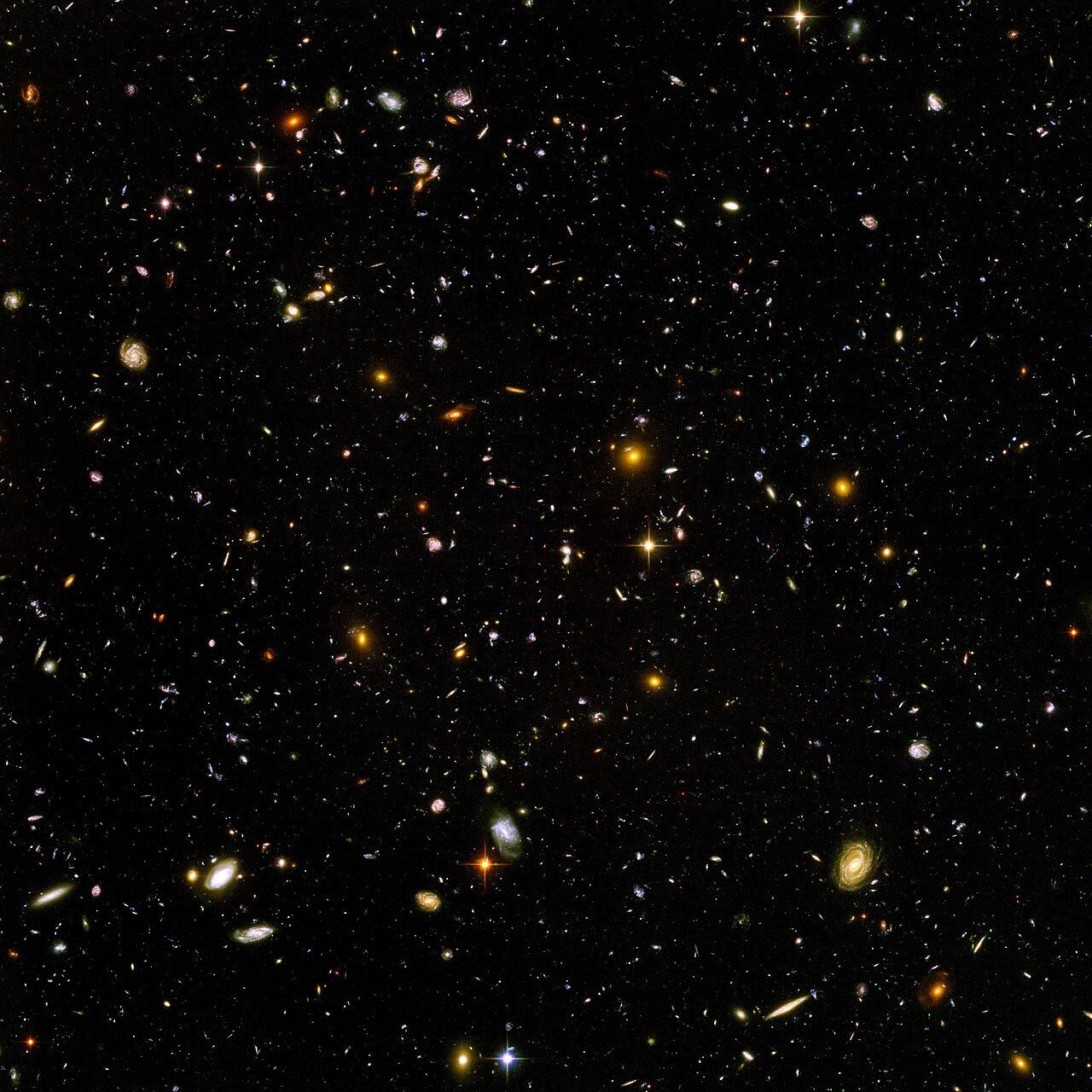
Relativity and quantum mechanics rebuilt physics on foundations their founders argued about in theological vocabulary — Einstein’s God who does not play dice, Bohr’s complementarity, Heisenberg’s uncertainty received (and resisted) as metaphysics. Georges Lemaître, a Belgian priest-physicist, proposed the primeval atom from which cosmology’s Big Bang descends, and then rebuked Pope Pius XII for claiming the theory as evidence for creation: the beginning of physics, Lemaître insisted, is not the beginning of Genesis. The episode is the century in miniature — a believer policing the boundary from the science side.
War industrialized research. The Manhattan Project made physicists into state counselors and then into penitents; Oppenheimer’s security hearing made the scientist’s conscience a public question. Medicine’s century ran from antibiotics to the double helix (1953) to the transplantation era, each advance generating its ethics committees, many of them staffed by theologians — Paul Ramsey’s work on medical ethics is unthinkable without the century’s technologies to answer.
The creation-evolution controversies narrowed to particular places and polities even as they grew louder: Scopes (1925), the Arkansas and Louisiana statutes struck down in Epperson (1968) and Edwards (1987), and Kitzmiller v. Dover (2005) on intelligent design. Globally, the century also saw the great missionary-founded universities of Asia and Africa become research institutions, and the Soviet state’s attempt to run science on an official atheism — Lysenko’s genetics the standing exhibit of what happens when any worldview, including a materialist one, is given police powers over conclusions.
The Worldview Stakes
The century’s lesson is institutional: whoever funds and licenses research shapes it. Churches lost their old licensing power; states and markets gained it; and the arguments migrated from cosmology to conscience — what may be built, tested, and used. Lemaître’s boundary work and the Manhattan Project’s aftermath both belong to that migration.
Elsewhere on This Site
References
- Helge Kragh, Cosmology and Controversy (1996)
- Ronald L. Numbers, The Creationists (expanded ed., 2006)
Related Across the Site
- Enlightenment Science Era — The philosophes made knowledge a program against priestcraft while physico-theologians mined the same discoveries for design; deism flourished and thinned; chemistry and natural history professionalized.
- Greco-Roman Science Era — Greek natural philosophy separated explanation by nature from explanation by myth, while Roman engineering turned knowledge into aqueducts, roads, and concrete — and physicians and astronomers worked for patrons of every cult.
- Islamic Golden Age Science Era — Under the Abbasid caliphs, Baghdad’s translation movement turned Greek, Persian, and Indian learning into an Arabic science that advanced astronomy, optics, algebra, and medicine — and argued about philosophy’s place beside revelation.
- Medieval European Science Era — Latin Christendom built the university, recovered Aristotle through Arabic and Greek, and debated the eternity of the world, the plurality of worlds, and the freedom of God — inside theology faculties, not against them.
- Nineteenth Century Science Era — Professional science, deep time, and Darwin; the warfare story was written in this century by Draper and White, while many of the era’s leading scientists — and many churchmen — saw no war to fight.
- Patristic Science Era — The Church Fathers received Greek learning as a handmaid: useful for reading Scripture and ordering life, subordinate to revelation, and preserved — selectively — through the collapse of Roman institutions.
- Renaissance and Reformation Science Era — Print, recovered Greek texts, and confessional rivalry reshaped European knowledge: Copernicus the canon published a heliocentric cosmos, Vesalius remade anatomy, and Jesuit colleges became engines of mathematical science.
- Scientific Revolution Science Era — Kepler’s ellipses, Galileo’s telescope and trial, Boyle’s Christian experimentalism, and Newton’s designed cosmos: the century that invented modern science also shows why the simple war story fails — most of its soldiers were believers arguing with believers.