

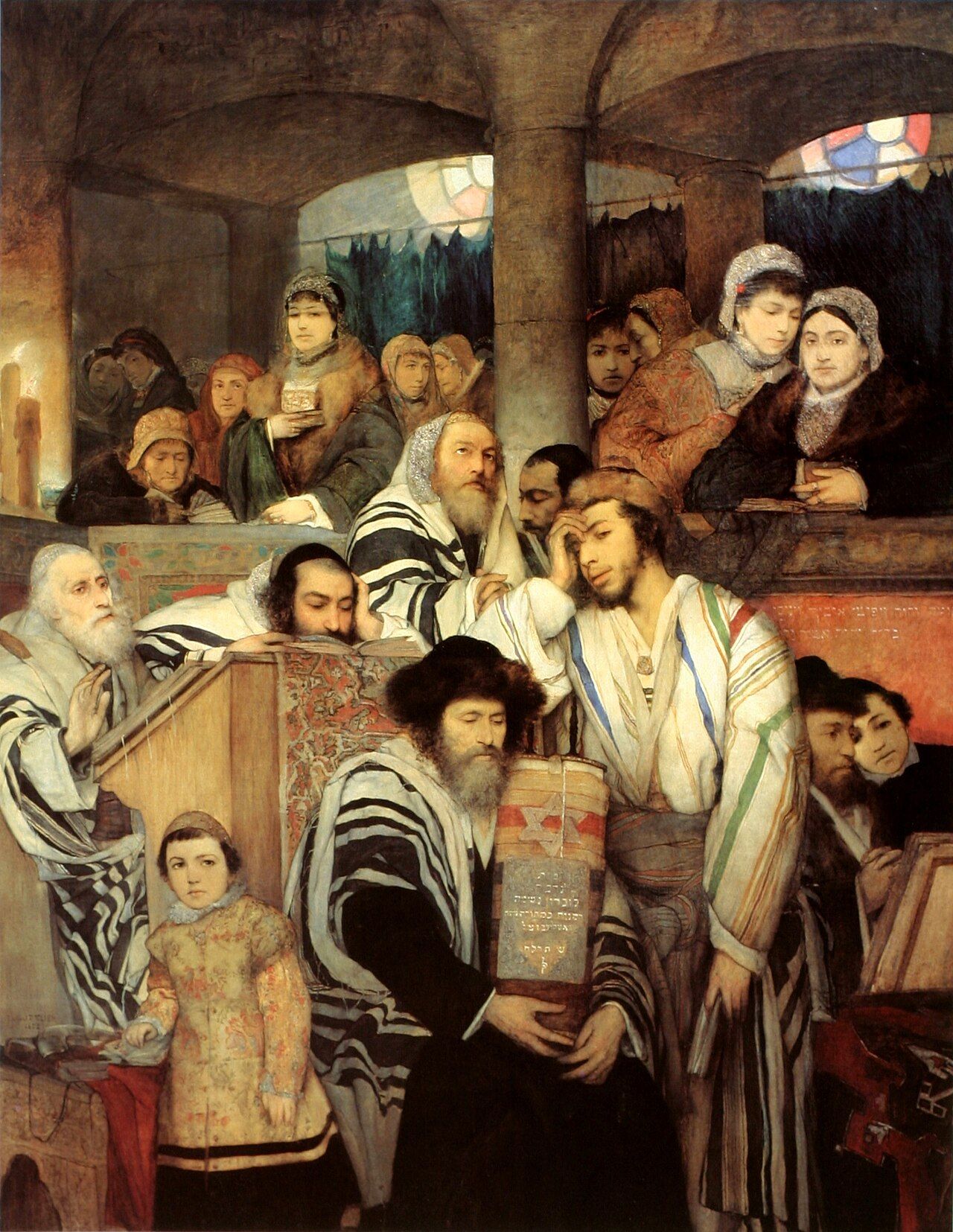
On weekday mornings, leather boxes containing Scripture are bound to the arm and the head for the morning prayer.
Tagged: Prayer Remembrance Scripture Jewish
How It Is Practiced
The tefillin are two black leather boxes. One is bound to the upper arm, facing the heart, its strap wound seven times around the forearm and hand; the other sits on the forehead between the eyes. Inside each are parchment scrolls inscribed with four passages of the Torah, including the Shema and the command itself: 'You shall bind them as a sign on your hand, and they shall be as frontlets between your eyes.' They are worn for the morning service on weekdays — not on the Sabbath or festivals, which are themselves called signs.
Purpose and Meaning
The practice takes the Torah's words as literally as words can be taken: the teaching is bound to the hand that acts and the head that thinks, so that deed and thought begin the day under the same word. The box on the arm faces the heart — affection itself is bound. For many who wear them, the few minutes of winding and unwinding are the day's most concentrated act of belonging.
References
- Tefillin — Wikipedia Free / open access
Related Practices
- The Three Daily Prayers — Jewish devotion is structured by three daily services — morning, afternoon, and evening — built around the Shema and the Amidah.
- The Mezuzah — A parchment scroll inscribed with the Shema is fixed to the doorposts of the home, touched in passing as a reminder of the covenant.
- The Brown Scapular — The Brown Scapular is two small squares of brown wool worn over the shoulders as a sign of belonging to Mary.
Related Across the Site
- Reciting the Psalms (Tehillim) Devotion — The Book of Psalms is Judaism's prayer book within the Bible, recited whole in cycles and verse by verse in trouble, illness, and thanksgiving.
- The Mezuzah Devotion — A parchment scroll inscribed with the Shema is fixed to the doorposts of the home, touched in passing as a reminder of the covenant.
- The Mourner's Kaddish Devotion — For eleven months after a death, and on every anniversary, mourners stand among the congregation to sanctify God's name in an ancient Aramaic prayer that never mentions death.
- Amidah Prayer or Creed — The standing prayer at the center of every Jewish prayer service, recited silently while standing.
- Birkat HaMazon Prayer or Creed — The Grace After Meals, a set of blessings of thanksgiving recited after eating a meal with bread.
- Kaddish Prayer or Creed — An Aramaic prayer sanctifying God's name, best known in its form recited by mourners.
- Shema Prayer or Creed — Judaism's central affirmation of the one God, drawn from Deuteronomy 6:4 and recited morning and evening.
- The Lord's Prayer (Our Father) Prayer or Creed — The prayer Jesus taught his disciples in Matthew 6 and Luke 11, shared by Christians of every tradition.